 English
 Español
 Français
 Deutsch


Aluminium Investment Casting: EIPC’s LUISA Process
In aluminium investment casting, the ability to reproduce complex geometries with thin walls and internal cavities comes with a well-known limitation: the cooling rate of the cast component. EIPC has developed its own proprietary process, LUISA, which addresses this variable and delivers measurable improvements in the microstructure and mechanical properties of Al-Si-Mg alloys.
How to achieve complete ceramic mould filling without compromising the metal’s microstructure
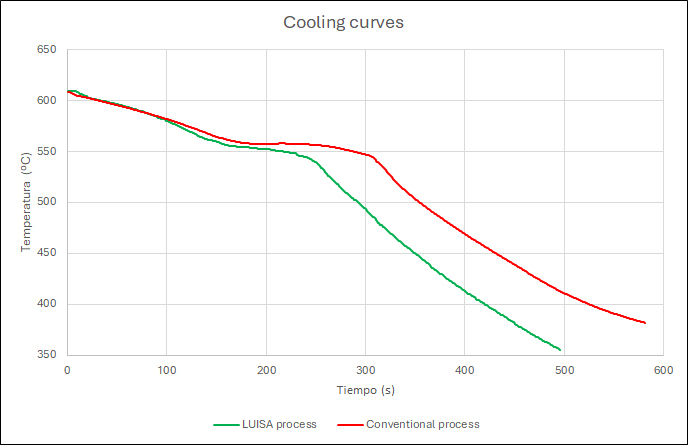
To ensure complete filling of thin sections and long flow paths, the ceramic shell mould is preheated to a temperature close to the melting point of the alloy. This improves castability but reduces the thermal gradient between the metal and the mould, thereby increasing solidification time.
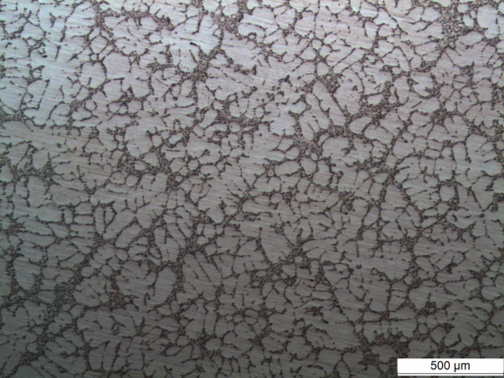
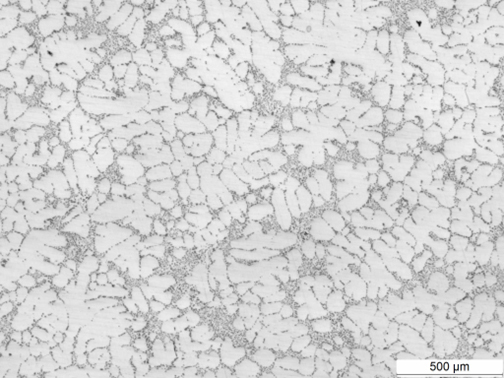
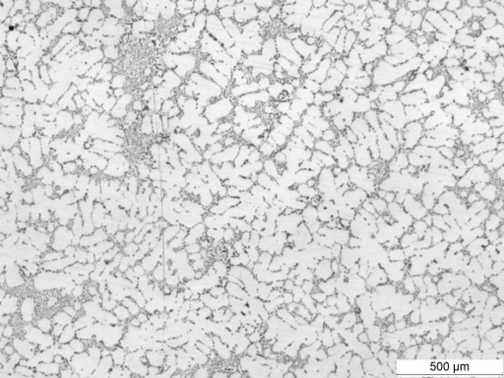
The result is a coarse as-cast microstructure. Dendrite arm spacing (DAS) is inversely related to the local cooling rate, meaning that slower cooling results in wider dendrite arm spacing and a coarser eutectic microstructure. This leads to strength and, above all, elongation values that fall short of the alloy’s full potential.
Controlled solidification processes
Several controlled solidification processes are currently available that aim to accelerate the cooling of aluminium castings without compromising mould filling.
At EIPC, we addressed the same challenge by developing our own solution: LUISA.
The LUISA process
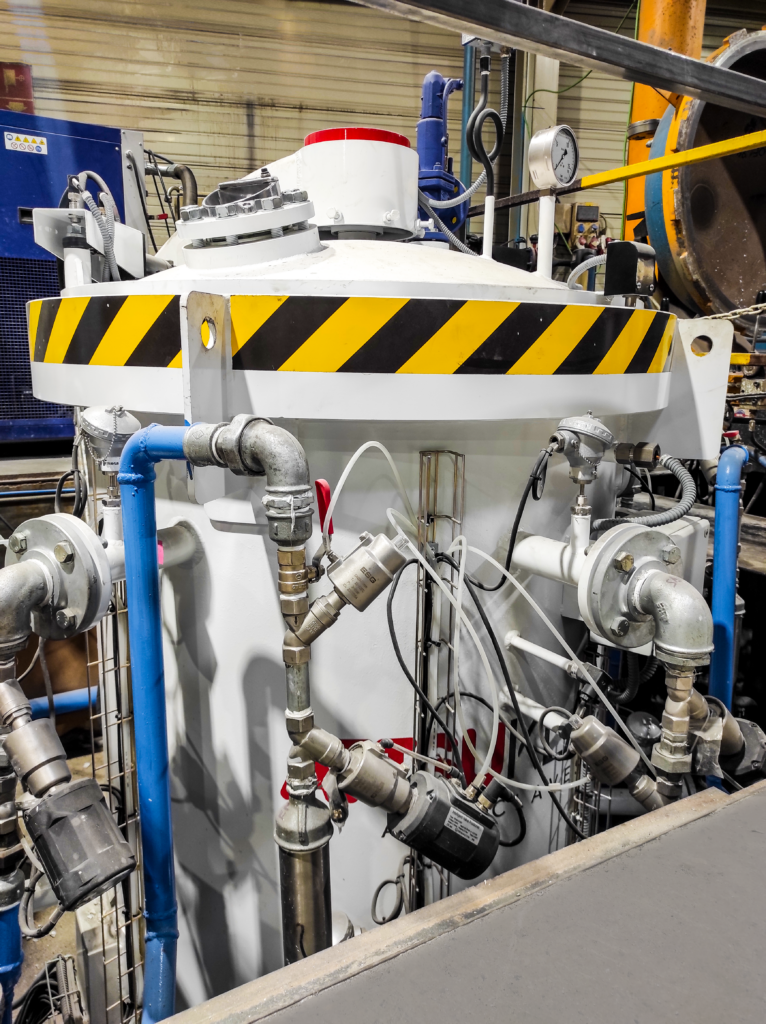
LUISA (Low-temperature Unidirectional-controlled-flow Improved cooling System for Aluminium casting) is a proprietary accelerated solidification process developed by EIPC. The process enables precise control of the cooling rate, reducing both eutectic solidification time and dendrite arm spacing (DAS).
| Parameter | Conventional | LUISA | Variation |
| Eutectic solidification time (s) | 124 | 78 | −39 % |
| DAS (µm) | 60 | 45 | −25 % |
| Elastic limit Rp0,2 (MPa) | 257 | 281 | +9 % |
| Tensile strength Rm (MPa) | 308 | 334 | +8 % |
| Elongation, A (%) | 2,2 | 4,1 | +86 % |
Conventional process
Conventional process
LUISA process
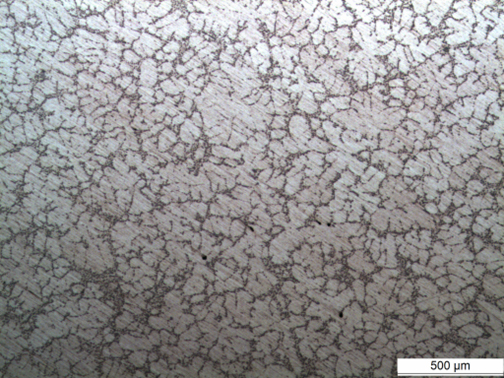
LUISA process
|
|
Eutectic solidification time (s) |
DAS (µm) |
Rp0,2 (MPa) |
Rm (MPa) |
A (%) |
|
Conventional |
124 |
60 |
257 |
308 |
2,2 |
|
LUISA |
78 |
45 |
281 |
334 |
4,1 |
|
|
|
|
+9% |
+8% |
+86% |
The increase in 0.2% proof stress (Rp0.2) and ultimate tensile strength (Rm) is consistent with microstructural refinement. The most significant result, however, is elongation, which nearly doubles. In casting alloys, an increase in strength is often accompanied by a loss of ductility. In this case, both properties improve simultaneously, providing greater design flexibility for components with demanding mechanical requirements.
The improvement has been verified both in separately cast test bars and in test specimens machined from an actual cast component. The latter result is particularly significant for industrial implementation, as the cooling rate within an actual component varies depending on section thickness and location, and separately cast test bars do not always reflect this variability.
Process control and traceability
LUISA operates as a fully automated system, recording process conditions and output parameters.
This data logging ensures batch-to-batch repeatability and provides documented process records, both of which are standard requirements in industries with stringent quality requirements, such as aerospace.
LUISA: a superior solution for enhancing component properties
Advanced controlled cooling techniques represent a paradigm shift in the pursuit of excellence in aluminium investment casting, enabling us to overcome conventional limitations and achieve mechanical properties that significantly exceed those typically obtained through traditional processes.
Our commitment to innovation is clear: LUISA represents a significant step forward in EIPC’s development of new manufacturing capabilities and continuous process improvement, enabling us to deliver products that meet and exceed our customers’ expectations.